Will Your Grandchildren Be Jews?
CLICK HERE TO SEE THE NEW INFOGRAPHIC
Our analysis of the raw data of the National Jewish Population Survey (“NJPS”) of 1990, which we titled “Will Your Grandchild Be Jewish?“ accompanied by an inter-generational demographic chart was first published in Moment magazine in October, 1996.(1)
Over the next two decades, our article and chart were translated into ten languages and appeared in many prominent publications, including two full page ads in The New York Times (2) based on the chart and was the only illustration cited by Professor Alan M. Dershowitz in The Vanishing American Jew(3).
In the first iteration of our article, we concluded that short of a major change in the choices made with respect to their commitment to Judaism, the vast majority of American Jews between the ages of 18-29 will not have Jewish descendants within the next three decades. The conspicuous exception to this trend is American Jews or their descendants who identify themselves as being Orthodox. In this updated version of our article, we have utilized a similar format to its namesake published after the culmination of the NJPS 2000-2001.
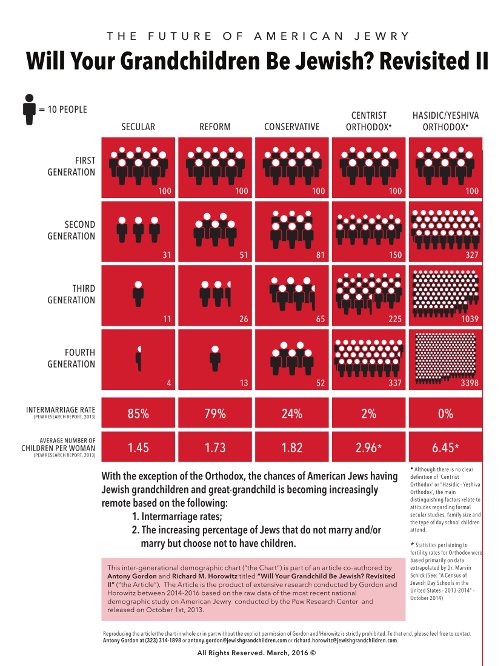
On October 1, 2013 The Pew Research Center Survey of U.S. Jews (“The Pew Survey”), released the most comprehensive national study of the American Jewish population conducted over the past 12 years, reported in A Portrait of Jewish Americans: Findings from a Pew Research Center Survey of U.S Jews. The overall muted response of The Pew Survey belies the far reaching impact of the study for the future of American Jewry.
The magnitude of the results of The Pew Survey, together with the indifferent response by the majority of Jewish activists in America was aptly captured in a seminal piece penned approximately a year after The Pew Survey was published by two of the most respected and most oft-cited Jewish sociologists in America – i.e. – Professor Jack Wertheimer, the former Provost of the Jewish Theological Seminary of America and Professor Steven M. Cohen, a research Professor at Hebrew Union College as follows:
“American Jews now stand on the precipice of a demographic cliff, and the choice before them is simple: either fall off, or turn around. Alas, much of organized Jewish life – which is to say, much of American Jewish leadership – shows no sense of urgency but proceeds as if a few small tweaks will miraculously reverse the destructive patterns eroding secular and Non-Orthodox Jewish life.
Seeing their roles as cheerleaders, reasoning that donors and volunteers can be recruited only if guaranteed of success, too many leaders cannot bring themselves to admit that American Jewry is in the midst of a deep-seated crisis.”(4)
Non-Orthodox American Jewry is facing an existential threat due to the following:
(1). An increase in American Jews who never marry which results in below replacement fertility rates;
and
(2). An increase in the rate of intermarriage.
According to The Pew Survey, 71% of non-Orthodox marriages from 2005 until the release of The Pew Survey in 2013 are intermarriages5. Stated in generational terms, the raw data6 from The Pew Survey provides overwhelming evidence that American Jewry has about 20 years left to utilize every creative method to try to reverse current trends in order to prevent as many American Jews as possible from falling off the “demographic cliff.”
For anyone concerned about the continuity of the Jewish People, The Pew Survey also highlighted a number of examples evidencing the increase in assimilation in America, including the following:
62% of American Jews report that being Jewish is primarily a matter of ancestry and culture; and
20% of American Jews describe themselves as having no religion at all.
In light of these trends, unfortunately things do not bode well for Non-Orthodox Jews in America.
METHODOLOGY
The extrapolations and conclusions noted in this article are based on an analysis of the raw data of The Pew Survey. In addition, we are indebted to Dr. Marvin Schick, educational consultant for the Avi Chai Foundation with whom we had several conference calls in order to ensure that we were utilizing the most accurate and current data with respect to variables within the Orthodox denomination.(7)
Demographic Disaster
The Pew Survey indicated that there have been no signs of reversal in the rate of assimilation in America as compared to the NJPS of 1990 and NJPS 2000-2001. On the contrary, it is evident from The Pew Survey that the non-Orthodox Jewish population is continuing on a path of demographic self-destruction.
Intermarriage and Never Married
Intermarriage rates have historically been the ‘bell weather’ for quantifying assimilation over the years. The Pew Survey found that intermarriages rates have increased significantly over the decades. Among non-Orthodox Jews, The Pew Survey found that there is a direct correlation between lower levels of interaction and engagement in traditional Jewish activities and a significant increase in the number of Jews who never get married as well as the rate of intermarriage.
Although it would seem counterintuitive, The Pew Survey did highlight one positive trend in terms of Jewish survival with respect to children of intermarried couples. Among the children of intermarried couples there was a statistically significant increase in the percentage of adults with intermarried parents who identify as Jewish. In the 18 to 29 age cohort this increase was 59%, while in the 30-49 age cohort the percentage of adults with intermarried parents who identify as Jewish increased by 39%.(8) While there is reason to be optimistic with respect to this trend, it will likely take approximately 20 years to have credible statistical evidence to quantify how the increase in children of intermarried couples identifying more as Jews may impact Jewish continuity.
The fact that intermarriage is the end of the line for a large percentage of children of mixed-marriages is aptly pointed out by Professor Jack Wertheimer as follows:
“The Pew findings unequivocally support Himmelfarb’s more hardheaded conclusion. Among those findings, as many as 2,100,000 Americans of some Jewish parentage – overwhelmingly, the offspring of intermarried parents do not identify themselves as Jews. Our analysis of Pew and other national and local surveys also shows that intermarried families are considerably less likely to join synagogues, contribute to Jewish charities, identify strongly with Israel, observe Jewish religious rituals, or befriend other Jews. Exceptions aside, the large majority of intermarried families are loosely, ambivalently, or not at all connected to Jewish life.
What we know about the adult children of intermarried parents is even less heartening. It is true that among all such adults between the ages of eighteen and twenty nine, as many as 59 percent identify as Jews. For Ted Sasson of Brandeis University, these are grounds for cautious optimism. But until these eighteen-to-twenty-nine-year-olds themselves marry, we can only speculate about their later relation to Jewish life – and on this score, there is little cause for optimism. When children of intermarriage do choose a spouse, reports Pew, 83 percent follow their parents’ model and marry non-Jews.(9)”
Intermarriage is only possible for those who marry
At the time of The Pew Survey, less than one third of non-Orthodox Jewish males, and barely two-fifths of Jewish women between the ages of 25 and 39 were married. For those between the ages of 40 and 44, the marriage rate climbs, but does not exceed 68% for men and 58% for women.(10)
Clearly for anyone concerned about the continuity of the Jewish People, it is disheartening to learn that today’s younger generation is delaying family formation, and, for an increasing percentage, the traditional family model no longer exists.
Who has time for kids anyway?
Overall, an analysis of the raw data culled during The Pew Survey indicates a fertility level of about 1.7 children for non-Orthodox Jews, well below the national replacement level in America of 2.1 children. The shrinkage is already visible, having resulted in a drop of nearly one-third in the cohort of non-Orthodox Jews under the age of 18 compared with the cohort between the ages of 40 and 58. Orthodox Jews remain the only denomination which has a fertility level that significantly exceeds the national replacement level and it is evident from The Pew Survey that they are growing both in absolute and relative terms.
For any observer of sociological and demographic trends related to the American Jewish population, it is evident that family values and child-centeredness is no longer the raison d’etre of most non-Orthodox American Jews.
THE NEXT 20 YEARS
Mitigating Factors: A positive demographic trend
While the underlying findings of The Pew Survey indicate that the vast majority of unaffiliated American Jews as well as those affiliated to non-Orthodox denominations have become disconnected from their Jewish roots, the opposite trend seems to be occurring with respect to those American Jews who are affiliated to the Orthodox denomination – i.e. – an increase, both in terms of numbers as well as influence on American Jewry.
Professor Steven M. Cohen underscored this trend in a leading article in The Jewish Week11. While Cohen conceded due to the disparity in methodologies utilized by the NJPS 1990 and The Pew Survey that it is difficult to make an “apples to apples” comparison, nevertheless he did note in connection with The Pew Survey that “the sheer number of American adult congregants who identity as Orthodox (be it Charedi, Modern Orthodox or other) leapt from 220,000 [in 1990] to 448,000 [in 2013].” In terms of the significance of this trend in the future, Cohen pointed out that “while Orthodox children up to age 17 amounted to 85,000 in 1990, the comparable population more than quadrupled, reaching about 350,000 in 2013.”
Statistically significant trends connected to Orthodox Jews in America
While The Pew Survey clearly indicated that the prognosis for Jewish continuity for most American Jews does not bode well, significant positive trends connected to Orthodox Jews in America need to be noted not only to highlight some of the bright spots in The Pew Survey but perhaps to also get a clearer indication of the changing spheres of influence in American Jewry.
Some of the most important of these trends include the following:
a) Starting in 1959 by NSCY with High School students and joined in the 1970’s with College students and adults by organizations such as Chabad and Aish Hatorah, the Orthodox movement in America has become increasingly involved in educational outreach to non-observant Jews. These outreach initiatives have increased exponentially in each decade with a noticeable impact;
b) The Pew Researchers noted that pursuant to The Pew Survey, it would be within the statistical margin of error to represent that 8 ½ % of the 5,250,000 Jewish adults in America would be categorized as Orthodox;
c) The Pew Researchers concluded that of the 8 ½ % of Orthodox Jews mentioned in (b) above, 30% were not raised Orthodox;
RANGE OF PROVEN SOLUTIONS
1. The Impact of the Jewish Day Schools
The direct correlation between an intense Jewish Day School and post Day School education for twelve years or more on the one hand, and loyalty to traditional Jewish values and beliefs on the other, is well documented112. The impact of a solid Jewish education and the long term commitment to Jewish continuity for the long term is aptly summarized by Professor Jack Wertheimer as follows:
“If, in the aggregate, more Jewish education means more Jewish engagement, more Jewish education also means higher levels of in-marriage. Similarly, those with more intensive Jewish educational experiences are most likely to be raising their children in the Jewish religion, to feel a sense of responsibility for other Jews, and to participate in religious and synagogue life. In line with these data are findings on the beneficial impact of Jewish summer camps, especially those that combine camping with a strong educational mission, thereby offering an organic experience of Jewish life that reinforces and compliments formal Jewish education of any kind. In brief, the most sustained and immersive forms of Jewish education are associated with the best later outcomes. To imagine otherwise is illusory.”
2. Jewish Day Camp with traditional Jewish content
A number of studies conducted over the past several years indicate clearly that the bonding experience of ‘sleep away camp’ instils long lasting behaviors related to Jewish practice. Among the reasons that Jewish Day Camps have yielded success over the years is the fact that the Jewish educational aspect which campers experience is in the context of a joyous and memorable experience.
This association tends to leave a positive and favorable impression. Most significantly several follow up reports indicate that these camps have a measurable impact upon adult Jewish involvement years later (13).
3. Youth Programs
Organizations such as Nifty, BBYO, USY, Young Judea and NCSY are have been shown to be effective to ensure that those young American Jewish youth who participate in outreach programs under the auspices of these organizations feel understood, validated and appreciated during their formative teenage years.
Worthy of specific note is the fact that in study of NCSY in 1998, it was found that among those former members of NCSY who did not identify themselves as Orthodox, the intermarriage rate was only 4%.(14)
A number of recent sociological studies have all concluded that the vast majority of children who have positive experiences associated with the Jewish youth program that they attended as teenagers usually maintain a positive association with traditional Judaism later in life(15).
4. Campus Programs
The increase in Anti-Semitic rhetoric on campuses in America, compounded by the pressure placed on college students to embrace a life style that is contrary to traditional Judaism, has resulted in traditional Jewish Campus Outreach Programs becoming one of the few advocates of Torah based content at Colleges across America. The need to bring resources to Campus Outreach Programs is likely to become an area of major focus amongst philanthropists committed to Jewish continuity in the years ahead. 16
5. Subsidized Trips to Israel
The impact of experiencing time in Israel with one’s peers has been proven to have a positive impact on Jewish continuity. Any discussion of the influence of trips to Israel has to clearly be centered around the remarkable number of young Jews who have experienced Israel thanks to Taglit-Birthright Missions to Israel (“The Birthright Experience”). The long term impact of The Birthright Experience is best described in the findings of a recent survey (“The Survey”) which examined the impact of Taglit-Birthright Israel on its alumni five to nine years after their visits to Israel as follows:
“Evidence from the present study makes clear that, in terms of attitudes as well as behavior, participation in Taglit-Birthright Israel alters the trajectory of Jewish identification and engagement. The significant and substantial differences in attitudes and behavior indicate that the program has had substantial impact.” (17)
With respect specifically to Jewish continuity some of the key findings of The Pew Survey include the following:
i) Among married respondents, Taglit participants were 51% more likely than nonparticipants to be married to a Jew; and
ii) Among all childless respondents, Taglit participants were 35% more likely than nonparticipants to view raising their children Jewish as “very important.”
The impact with respect to changes in life perspectives and attitudes following The Birthright Experience, as noted in points (i) and (ii) above, lead the authors of The Survey to conclude as follows:
Many of the most successful and established outreach organizations which target the age group that qualify for The Birthright Experience, including but not limited to Chabad, NCSY, Aish, MEOR and Ashreinu have credited The Birthright Experience for not only making it financially possible for students affiliated to these organizations to experience a trip to Israel but furthermore, these organizations also benefit from the opportunity of being able to follow up with students after they have experienced the spiritual high and Jewish nostalgia that has become synonymous with such a trip to Israel.
CONCLUSION
The Pew Report seems to indicate that unfortunately increasingly it will be left to Orthodox Jews to keep the flame of Judaism burning in America. On the contrary, perhaps the appropriate response to the dangerous erosion of the commitment in many parts of American Jewry is the approach taken by First Responders arriving on the scene of multiple traumas – i.e. – we have a limited amount of time left before we reach the demographic tipping point of no return. In light of the fact that there is also limited capital and resources to be deployed, we submit that the focus of any responsible Jew who cares deeply about Jewish continuity is to support the various proven initiatives that are having an impact on reversing the increased trend towards assimilation.
The call to action for every Jew in America is simple. We have highlighted a number of tried and tested ideas which have been proven to increase the chance of ensuring that one has identifiable Jewish descendants. In conclusion, The Pew Survey is a challenge to our complacency and is only as useful as the response to it.
FOOTNOTES
1. “Be Fruitful Indeed,” Moment, October, 1996, p 26.
2. Tuesday, March 3rd, 1998.
3. 1997, Published by Little Brown & Co, page 26.
4. November 2, 2014, Mosaic Magazine – Jack Wertheimer and Steven M. Cohen.
5. This observations, among others comments were explicitly pointed out by Alan Cooperman, the Director of Religion Research at the Pew Research Center to Rabbi Yaakov Palatnik in a series of e-mail exchanges towards the end of 2013. Mr. Cooperman, together with Gregory A. Smith, the Associate Director of Research at Pew Research Center was responsible for designing, executing and evaluating the impact of The Pew Survey.
6 .The Jewish population analyzed in the Pew Raw Data Analysis consists of those whose religion is Judaism Jews by Religion”), those who are Jewish in some way other than religion (“Jews not by Religion”), and those born Jewish but who no longer identify as such (“Jewish Background”). The percentages noted were based on statistical calculations in order to yield estimates falling within a 95% confidence interval.
7. The extrapolations and conclusions noted in this article are based on an analysis of the raw data of The Pew Report facilitated by Alan Cooperman with further in depth analysis conducted by Janet Aronson, Ph.D and Matt Brown, Ph.D under the supervision of Len Saxe, Ph.D., the Social Policy Director at Steinhardt Social Research Institute and Cohen Center for Modern Jewish Studies at Brandeis University.
8. “... Pew’s own data shows that the growth of the unaffiliated population is the result of the unexpected tendency of most young adults with intermarried parents to identify as Jewish. Instead of a growing population of young adults raised in Jewish households opting out, there appears to be a trend of young adults raised in non- Jewish or partly Jewish households opting in.” (“New Analysis of Pew Data: Children of Intermarriage increasingly identify as Jews.” Tablet Magazine, November 11, 2013 by Theodore Sasson).
9. Ibid – Footnote 4. – Jack Wertheimer and Steven M. Cohen – November 2, 2014, Mosaic Magazine.
10. Ibid.
11. The Jewish Week – “Lessons Learned from Orthodoxy’s Dramatic Growth.” December 8th, 2015 – Steven M. Cohen.
12 . The impact of varieties of Jewish Education upon Jewish Identity: An Inter-Generational Perspective,” Brandeis University Press in conjunction with AVI CHAI Foundation, Steven M. Cohen, 2007; Far- Reaching Effects of Extensive Jewish Day School Attendance: The Impact of Jewish Education on Jewish Behavior and Attitudes, Research Report 2. David J. Azrieli Graduate Institute of Jewish Education and Administration, Yeshiva University, July, 1994, New York, Schiff, Alvin I. and Schneider, Marelyn; When They Are Grown They Will Not Depart: Jewish Education and the Jewish Behavior of American Adults; Cohen Center for Modern Jewish Studies, Brandeis University, Barak Fishman, S. and A. Goldstein, 1993; Teach Your Children When They Are Young: Contemporary Jewish Education in the United States, “Cohen Center for Modern Jewish Studies, Brandeis University, Goldstein, A. and S. Barak Fishman, 1993 etc.
13. Camp Works – Steven M. Cohen, Ron Miller, Ira M. Sheskin and Berna Torr, Foundation for Jewish Camp, 2011; The Jewish Learning Presence in JCC Day Camps – Prof. Steven M. Cohen and Eitan Melchior, JCC Research Center, March 10, 2011.
14. NCSY Study, Lilly Endowment, Nathalie Friedman, 1998.
15. BBYO impact study, The Charles and Lynn Schusterman Family Foundation and conducted by independent research firms, Groeneman Research & Consulting and Gerstein; 2010.
16. Nitzotzot Min HaNer, Kiruv on Campus, Volume # 9, February 2003.
17. The Impact of Taglit-Birthright Israel: 2010 Update, Leonard Saxe, Theodore Sasson, Shahar Hecht, Benjamin Phillips, Michelle Shain, Graham Wright, and Charles Kadushin, Maurice and Marilyn Cohen Center for Modern Jewish Studies, February, 2011 Brandeis University.
by Antony Gordon and Richard Horowitz
Posted in:
RELATED ARTICLES

RELATED MEDIA