Why Keep Kosher?
Why Keep Kosher? | The Reasons for Keeping Kosher

Contents
- Foreword
- The Laws of Kashrut
- Does the authority of a commandment rely upon our comprehension of its rationale?
- Do all the commandments have reasons that are comprehensible to the human mind?
- How is it possible for a human being to attribute reasons and motives to G-d’s will?
- What is the purpose of studying the reasons for the commandments?
Foreword
 |
Few activities are as instinctive as eating, and few activities have such a profound impact on us physiologically, psychologically and spiritually, as eating. Many people do not give much thought to when, what and how they eat until their cardiologist tells them to lower their cholesterol or their friends begin to ask if they are pregnant (for men this question is especially disturbing). Jews who observe the Jewish dietary laws (Kashrut) however, must make regular decisions about what they eat, when they eat it and how they prepare their food; so that for the observant Jew eating ceases to be a totally instinctive activity. The dietary laws force us to stop and think about daily activities and deter us from going through life in auto-pilot. In order to understand what the Torah wants us to think about, and to understand the philosophy and rationale of the dietary laws it is necessary to be at least superficially familiar with the kashrut laws themselves.
The Laws of Kashrut
(top)1. The first category of kashrut laws deals with animals and their byproducts.
- A kosher animal must be a ruminant (chew its cud) and have split hooves - so cows, sheep, goats and deer are all kosher, whereas camels (ruminants without split hooves) are not kosher, and pigs (having split hooves but not chewing their cud) are not kosher. Most common fowl are kosher, like chickens, ducks and geese, but the birds of prey (hawks, eagles, owls, parrots) are not kosher. A sea creature is only kosher if it has fins and scales, so most species of fish are kosher (tuna, salmon, flounder, trout, etc.) but all shellfish are not kosher; dolphins and whales are not kosher, jellyfish, sea slugs (my sincere apologies about this one) and squids are not kosher either. There are four species of locust that are kosher, but are not commonly consumed by the majority of Jews (Thank G-d for that). Any product of a non-kosher animal is also non-kosher (e.g. milk, gelatine, rennet). The exception to this rule is bee’s honey.
- In order to eat an animal or bird it must be slaughtered according to Jewish law (Shechita). This involves cutting the animal’s trachea and oesophagus (the carotid artery and jugular veins are also severed in this operation, as are most arteries and veins leading to and from the brain) with a surgically sharp knife that has been thoroughly checked for nicks beforehand. The cut must be swift, without pause, tearing or vertical pressure and must be only done by an expert. It must be performed on the neck of the animal not higher than the epiglottis and not lower than where cilia begin inside the trachea. This method of slaughter reduces the blood pressure in the brain to zero immediately so that the animal loses consciousness in a few seconds and dies in less than a minute. (For comparative scientific studies of shechita and other methods of killing, refer to Shechita: Religious, Historical and Scientific Perspectives, by Munk, Feldheim Publishers, New York, 1976) Fish must be killed before being eaten, but no particular method is specified in Jewish law.
- The animal or bird must then be determined to be free of treifot, which are 70 different categories of injuries, diseases or abnormalities whose presence renders the animal non-kosher.
- Not all parts of the animal may be eaten. Certain fats, known as Chelev, may not be eaten. As much blood as possible must be removed from the meat, either by soaking, salting and rinsing or by broiling over a fire. In addition the sciatic nerve (gid hanasheh) in each leg and the fat surrounding the nerve must be removed.<\li>
- It is forbidden to cook (even without eating), eat (even without cooking) or derive any benefit (e.g. feeding pets) from mixtures of milk (and its by-products), and meat (and most of its by-products). It is also forbidden to cook or eat dairy products together with poultry. Fish, fruits, vegetables, grains, eggs are neutral (pareve).
 |
 |
2. The second category of laws are those that deal with agricultural products.
- One may not eat of fruit of a tree in the first three years from the time of its planting. (Orlah)
- In the Land of Israel, tithes must be taken from all crops. Some tithes are divided among the Priests (Kohanim), Levites, and the poor. Others must be eaten in Jerusalem by the owners and shared with the local population. If these tithes are not separated out of the crop then the produce may not be eaten—the wheat, barley or fruit is actually not kosher until the commandments of tithing have been fulfilled.
3. The third category are products that were prohibited because of what they may contain or for their sociological impact.
- Wine and grape-juice products may only be used if produced by Jews. Pagans used to use wine for their ceremonies and used to dedicate wine to their gods, which would make the wine Biblically prohibited. The Sages forbade all “non-Jewish wine” even if it was not known to have been used for pagan purposes. In addition, sharing wine creates a certain feeling of intimacy that the Sages wanted to discourage between Jews and Gentiles as a barrier against intermarriage.
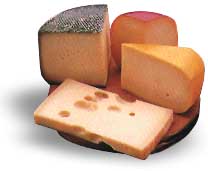
- Milk products must be supervised in order to ensure that they only come from kosher animals. The rennet in cheese must also only come from a kosher animal that has been slaughtered correctly and checked for treifot.
- Any cooked or processed foods must have some form of supervision to ensure that there are no non-kosher products used in their preparation.
- The first and most obvious idea behind the kosher laws is self-control and discipline. Let me illustrate this idea with a real-life example. Most parents are familiar with the horrors of going to the supermarket with young children. The worst part of this ordeal is waiting in line at the check-out counter. You have only five items (including two items that the child in the shopping cart swiped off the shelves without your knowledge), so you wait in the “eight-items or less” express line. The lady in front of you has 25 items at least, she is trying to pay with a third-party cheque from Paraguay in Thai baht, and is negotiating with the clerk over her expired coupons (and her mortgage). You are waiting with two children under the age of six, surrounded on both sides by four foot high canyon walls of sugar based products. The children are becoming increasingly impatient and begging for candies, and you are becoming more and more angry and frustrated as time goes on. Of course, most children will scream and beg and embarrass their parents into buying the candy (For those who are not parents, be assured that this is standard practice). Now for the true story. I moved with my family from Israel to Toronto for a four year stay, and in the first week was waiting in line at the supermarket (as described above, more or less) with one of my children. He asked me for a chocolate bar, I looked at the bar and told him that it was not kosher (really, it wasn’t kosher) and he was silent, accepting the decision without tantrums, threats, tears or hysteria. It struck me then, that my five year old, who has been brought up with the laws of kashrut, had more self-control than the millions of adults in the Western world. How many people accept “no” as an answer in denial of a pleasure that they want NOW? Dangerous? I will take precautions Unhealthy? I will stop after a few. Addictive? Not to me. Not to indulge is simply not an option. So one clear benefit of the laws of kashrut is self-control and discipline.
- I remember seeing an interview with a famous politician whose motto was “a kinder, gentler America.” The interview was conducted while he was engaged in hunting grouse on his estate. No one seemed to notice the contradiction between his recreational activity and his motto. How can one derive entertainment from pursuing and killing an animal and at the same time espouse a “kinder, gentler America?” In the words of one of our great Rabbis (Rabbi Yechezkel Landau, Responsa Nodah Biyehudah, Yoreh Deah 10)” I am amazed by this activity [hunting], we have not found hunters in the Torah except for Nimrod and Esau. This is not the way of the sons of Abraham, Isaac and Jacob ... one should not say “wear it out and renew out” to someone who has bought clothing made of animal skin, since it is written “His mercy is upon all his creatures.”...if so how can an Israelite kill living beings, without any other need than in order to pass his time by hunting?!... Therefore this matter contributes to a negative trait cruelty, and is forbidden and dangerous, and also causes Gd to judge the person for his sins…” It is true that in Jewish tradition we are allowed to use animals as food and clothing, however we are not supposed to rejoice in this, and we are certainly not supposed to make a sport of it. I believe that some of laws of kashrut are designed to prevent us from becoming callous and cruel and to discourage hunting as a form of recreation or sustenance. For instance, the requirements of shechita and treifot (see above 1b) virtually preclude the possibility of hunting an animal and then eating it. It must be still and under control when killed, it cannot be fatally injured, and it must be killed only by an expert.
- The prohibition against meat and milk also serves to remind us where our food comes from. The meat is from a dead animal, the milk from a living animal. “Do not cook a kid in its mother’s milk” - be aware that obtaining meat necessitates death, obtaining milk requires life. These are foods that have their origin in living creatures and keeping them separate makes us aware of their source. This is similar to the law that allows us to wear clothing of leather, but suggests that we do not wish our friend to “wear it out”, because getting a new one involves the death of an animal. (Code of Jewish Law, Orach Chaim, 223:6 Ramah ad loc.)
- In Hebrew the word for “charity” is “tzedaka”, which is more correctly translated as “justice.” We do not look at giving to the less fortunate as something beyond the call of duty, we perceive it as simple justice. Hence we can understand why the Torah prohibits a Jewish farmer from eating the produce of his own field until he has given tithes to those without land of their own. He is not being asked to be extra nice, he is being commanded to be just.
- Even the types of animals we eat are chosen in part for their symbolism. The ruminants that have split hooves tend to be tranquil, domesticated animals that have no natural weapons. These are animals whose characteristics we may absorb through eating. We may not eat scavengers, carnivores or birds of prey—these are not characteristics that we want to absorb at all.
-
There is no question that kashrut has contributed to our survival as a distinct nation as well. Jews all over the world have certain common dietary patterns. I can be confident that the curried hamin of the Jews of Calcutta has no mixture of milk and meat in its ingredients. When I eat French-Moroccan cuisine I know that the meat is not pork, the animals have been slaughtered according to law and the wine is produced by Jews. Jews meet each other at the local kosher bakery, they shop at the same stores and have their own butchers. These laws are a major force in maintaining unity, act as a social barrier against assimilation, and create a feeling of community amongst the Jewish people.
- Another aspect of the kosher laws is the encouragement of a certain degree of aesthetic sensitivity. Judaism prohibits the consumption of animals that have died of natural causes and animals that are deformed or diseased as well as prohibiting the consumption of insects and loathsome foods. It is possible that one idea behind this is too encourage us to view ourselves with dignity and to act with dignity. One of the best defences against doing that which is immoral, is a strong sense of self-esteem and dignity. Evil should be looked at as beneath our dignity, stealing is stooping too low, gossip is petty and small-minded. In order to help us achieve and maintain this level of dignity the Torah prohibits foods like carcasses and diseased animals. Through this we hope to fulfil the verse that states “And you shall be for me a kingdom of priests and a holy nation… (Deuteronomy 4:20)”
The above overview is obviously not a comprehensive legal guide to the laws of kashrut, it is a bare bones categorisation of the laws, for the purpose of understanding their rationale. For a more detailed exposition of the dietary laws, see The Jewish Dietary Laws, Isidore Grunfeld, Soncino Press, London.
Reasons for the Commandments
(top)
Before going into the reasons for the laws in detail a second introduction is necessary. When we attempt to explain the philosophy of any law of the Torah we have to understand some general ideas about the concept of taamei hamitzvot, reasons for the commandments.
The verse states, “Contemplate (“taamu”, literally “taste”) and see that G-d is good..” (Psalms 34:9) Judaism does not expect people to be capable of fulfilling the commandments without having any appreciation at all of their depth and beauty - their “taste.” Study of the reasons for the commandments (taamei hamitzvot) is perhaps one of the most effective methods of gaining this appreciation of the Jewish way of life. The very idea of investigating the reasons for the commandments, however, raises a number of issues.
1. Does the authority of a commandment rely upon our comprehension of its rationale?
- The idea of a reason justifying fulfillment of a commandment or giving authority to the Halachah is foreign to Jewish thought. G-d, the Creator and Master of all of existence, has the right to command, to forbid and to obligate us regardless of our lack of comprehension of the reasons behind His commands. In the words of Rabbi Samson Raphael Hirsch (Foreword to Horeb), “Even, therefore, if every Divine precept were a riddle to us and presented us with a thousand unsolved and insoluble problems, the obligatory character of the commandments would not in the slightest degree be impaired by this. Whatever command or prohibition of G-d it may be that prompts one to ask why one should do this and not do that, there is but one answer: Because it is the will of G-d…
In a similar vein, Rabbi Hirsch writes in a footnote to his book “The Nineteen Letters” (Eighteenth Letter), “As in Nature, the phenomenon remains a fact although we have not yet comprehended it as to its causes and connections, and its existence is not dependent on our investigation, but vice versa, thus also the components of the Torah remain the law even if we have not discovered the cause and connection of a single one.”
2. Do all the commandments have reasons that are comprehensible to the human mind?
Jewish scholars throughout time have all attempted to find reasons for the commandments, including the chukim or statutes (usually understood to be commandments that have no rationale comprehensible to the human mind). Nachmanides (Deuteronomy 22:6) points out that all commandments even statutes have reasons, and that “the absence of reasons for the Torah (that we can understand), is a result of our own intellectual blindness.” He quotes a statement of our Sages (Midrash Rabbah, Numbers 19:3-4) that G-d revealed to Moses the reasoning behind the laws of the Red Heifer, perhaps the archetypal statute, whose ashes purify the defiled, yet defile the pure.
Similarly Maimonides (Guide for the Perplexed 3:31) maintains that all the commandments have reasons. “Every commandment of the 613 commandments either imparts to us a true philosophy, eradicates a false philosophy, enforces a rule of social justice, nullifies injustice, bestows noble character traits, or warns against evil traits.” He qualifies this, however, and stresses that this is true only of the broad outlines of the commandment , and states that no human has any hope of understanding the reasons behind the details of a commandment (ibid., 3:26), “In my opinion, one who engages in creating reasons for the details of a commandment is acting under the influence of a major delusion.” (In contrast to the view of Maimonides, the Kabbalists and Rabbi S.R.Hirsch have given reasons for even the most minute details of the commandments.)
Maimonides directs us to investigate all of the commandments and to uncover as much of their reasoning as possible. As he states in Laws of Misappropriation (8:8), “It is correct for a person to investigate the laws of the Holy Torah and to know their purpose to the best of his abilities. If he does not find a reason or purpose in something it should not be light in his eyes ...he should not reject the commandments because he does not know their reasons, and he should not attribute false ideas to G-d or think about them as of profane matters…”
He also writes, “Even though all the chukim of the Torah are decrees, as we explained at the end of the Laws of Misappropriation it is correct to contemplate them, and to offer reasons wherever possible.” (Laws of Exchanges, 4:13. See also, Guide for the Perplexed, 3:48 and commentaries ad loc; Nachmanides, Deuteronomy 22:6. See also, Babylonian Talmud, Tractate Megilah 25a, Rashi and Tosfot, ad loc. where it is implied that there are no reasons for the chukim.)
3. How is it possible for a human being to attribute reasons and motives to G-d’s will?
- A human being cannot possibly hope to comprehend the infinite wisdom of G-d, and to understand His “motives” in commanding us to do a particular commandment or to refrain from a transgression. It is possible, however, for the human to understand what effect the commandment will have on himself and on the world.
Nachmanides (Deuteronomy 22:6) quotes the Midrash Rabbah (Genesis 44:1) which seems to address this issue. The Midrash asks, “What does it matter to G-d if an animal is slaughtered by cutting its neck through the spine or the throat?” The answer of the Midrash is, “The commandments were given in order to refine mankind, as it says “all the words of G-d are refined.” This suggests, that from G-d’s point of view there is no difference between kosher slaughter and unkosher slaughter, implying that it is futile to try to find a motive or a reason for a particular commandment other than its impact on the human being.
Nachmanides quotes a parallel midrash from the Midrash Tanchumah (Leviticus 12) as support for the above understanding of the Midrash Rabbah; “What does it matter to G-d whether we slaughter an animal or kill it and eat it? Can you at all aid Him or harm Him?!... If you have acquired wisdom, the wisdom is yours. Rather, the commandments were given in order to refine mankind…” According to Nachmanides, both the Midrashim are stressing the idea that the principal beneficiaries of the commandments are the Jewish people, not G-d. As the Midrash asks, “Can you at all aid Him or harm Him?!”—our fulfillment of commandments does not exert influence on G-d’s essence at all, rather they affect the person who performs the commandments, refining and elevating the human being.
Both Maimonides (Guide for the Perplexed 3:31) and Nachmanides understand that the reasons for the commandments not as the “motives” behind the commandments but as the side-benefits of the commandments; the impact that the commandments have on the individual, on society or on the universe as a whole. They disagree as to what those benefits are and as to how the commandments impart those benefits; Maimonides stresses the sociological and psychological whereas Nachmanides stresses the metaphysical. All agree, however, that the commandments have “reasons,” and that G-d does not benefit from our fulfillment of the commandments; rather, it is we who are refined by the commandments and it is humans who are the main beneficiaries.
My revered teacher, Rabbi Moshe Shapiro, once asked Rabbi Eliyahu Dessler to explain the term “taamei hamitzvot” (the Hebrew term used by the Talmud for the reasons of the commandments). Rabbi Dessler replied, “The taam of a commandment is the taste of a commandment .” Rabbi Dessler, translated the word taam literally, as ‘taste,’ and explained that just as we eat food in order to survive, we nevertheless enjoy its variety of tastes and textures as a pleasant side benefit of eating. Similarly, G-d made the commandments with varied “tastes”; we fulfill the commandments because they are the will of G-d and they are His instructions for living; but investment in the commandments also pays other dividends, which are explained in the literature of taamei hamitzvot.
4. What is the purpose of studying the reasons for the commandments?
- Rabbi Shapiro explained that according to Rabbi Dessler the principal purpose in the knowledge of the “taamei hamitzvot” is to make the commandments palatable to the person performing them, as an incentive for their fulfillment. As our Sages advise, “One should engage in Torah and commandments even for the wrong reasons [i.e. in order to obtain the benefits of the commandments] since this will eventually lead [to observance] for the correct reason [i.e. the love of G-d].” (Pesachim 50b, Mesoret Hashas, ad loc. See Petichtah Eichah Rabbah, 2)
Rabbi David Gottlieb commented that performing a commandment with a deep understanding of its function makes the fulfillment qualitatively better. The act of a commandment is not just a physical action; it involves heart and mind. He also explained that the taamei hamitzvot are explanations of how the behavioral rules of Judaism are connected to the goals and values of Judaism, and through the knowledge of the taamei hamitzvot we will have a more correct idea of what Judaism considers to be a value.
There may be another important reason for the study of taamei hamitzvot, based on a passage in Maimonides’s introduction to his commentary on Ethics of the Fathers (Shmonah Perakim, Chapter 6). In this chapter Maimonides discusses which is the higher level of morality, one who conquers his evil inclination, or one who has no inclination to do evil. Maimonides maintains that the higher level is the latter, a pious person (chasid); one whose desire is to do only good and who finds evil instinctively abhorrent. He brings support for this idea from the philosophers and from verses in Proverbs (21:10), “The soul of the evil person desires evil”; “The righteous person rejoices in acting justly” (21:15). Maimonides then quotes a number of statements of the Rabbis of the Mishnah and Talmud that seem to contradict this idea and imply that the highest level of piety is conquering the desire for evil. For example, the Sifrah (Parshat Kedoshim) states, “Rabbi Shimon ben Gamliel said ‘A person should not say, ‘I do not like meat and milk mixtures’... rather, he should say, ‘I would like it but what can I do? My Father in heaven has decreed upon me (not to partake of it).’”
Maimonides resolves this apparent contradiction in the following way. “Regarding the evils that the philosophers agree areevil, the Sages said that one who does not desire them at all is greater than one who conquers his desire… such as murder and theft… But regarding those evils that would be acceptable had the Torah not forbidden them, the Sages said that one should desire them and refrain from transgression only because of the Torah’s prohibition.”
According to Maimonides, it is desirable for a person to incorporate certain commandments into his character so that his performance of commandments or his refraining from transgression are not the result of internal struggle, but are the natural consequences of his personality. This is only true, however, of commandments whose rationale are apparent; with regard to chukim, obedience to G-d should be the only motivation in their fulfillment.
Knowledge of the rationale of the commandments is essential for incorporating the commandments into one’s personality and for the shaping of a Jewish instinct. One who fulfills the commandments in a dry, mechanical way, without “taste,” has less chance of being one who “rejoices in acting justly.” There are certain commandments, and perhaps particular aspects of every commandment , that are designed to instill in us loyalty and obedience to G-d, and to help us recognize that the authority of the Torah does not depend upon our understanding of it. The reasons for those commandments still remain concealed and beyond the grasp of the human mind, even after study. Perhaps that is precisely the taste that one is meant to detect in the chukim.
Rationale of the Dietary Laws
(top)
Keeping the above ideas in mind we shall now attempt to explore some of the rationale of the dietary laws.
 |
 |
Conclusion
(top)Some religions seek the path to spirituality through withdrawal from the physical world. A monastic life is glorified, celibacy and asceticism are seen as ideals. Some view the human as essentially an animal that is incapable of elevating itself beyond the struggle for survival, hence they encourage a life of hedonism and materialism. Judaism sees the human as an essentially spiritual being, clothed in a physical body. Judaism maintains that the physical is not evil, it is just not the complete view of reality. Judaism seeks to elevate the physical world, not to deny it, nor to glorify it. The laws of kashrut allow us to enjoy the pleasures of the physical world, but in such a way that we sanctify and elevate the pleasure through consciousness and sensitivity. Kashrut recognises that the essential human need is not food, drink or comfort, but meaning. Judaism, through the dietary laws, injects meaning even into something as commonplace and instinctive as eating.
origin: https://www.ohr.edu/yhiy/article.php/993 © Ohr Somayach International - https://www.ohr.edu
by Rabbi Mordechai Becher
Posted in: Commandments & Daily Living
RELATED ARTICLES